The Hidden Cost of Too Much Comfort & Security (And What to Pursue Instead)
In 1931 an Englishman named Aldous Huxley wrote a novel called Brave New World about a future society that apparently had it made. Through advanced technology and meticulous government systems, everyone in this society had comfort, security, and entertainment in endless supply.
But in the end, this “perfect” society turns out to be a nightmare. Too much comfort, security, and entertainment become a curse.
The individuals in this society gain near perfection in one area, but they lose the richness of being essentially human. They no longer struggle, suffer, love deeply, aspire grandly, or grow to be their best.
I don’t think you and I are living in Huxley’s dystopian world (yet!). But I’ve noticed security and comfort tend to dominate financial goals, especially for those of us pursuing financial independence.
We constantly strive to build more wealth, buy more insurance, and continue working for more money (“just one more year”). And a core motivation for all of this is to sleep more securely and more comfortably at night.
Of course, there’s nothing inherently wrong with these goals. But reflecting on the ideas in Brave New World made me wonder:
- What is the cost of prioritizing comfort and security too much?
- Is there a better approach?
My answers to those questions are what I’ll explore in the rest of this article.
Conflicted Human Yearnings
Allons! with power, liberty, the earth, the elements,
Health, defiance, gayety, self-esteem, curiousity;
Allons! From all formules!
From your formules, O bat-eyed and materialist priests.”~ Walt Whitman, “Song of the Open Road“
We humans are conflicted beings, aren’t we?
There is no doubt comfort and security are important. If you are living on the street and are cold, hungry, and exposed, wouldn’t a warm, secure, cozy place to lay your head be satisfying?
But what about the situation in Brave New World. From birth to death, the citizens of this society never hunger, feel pain (thanks to feel-good drugs with no side effects), nor want for any comfort.
Yet, you can’t read about this futurist society without getting a chill down your spine. It’s like the people became robots that only look like real on the surface.
So, it seems that a single-minded pursuit of security and comfort at all costs misses something vital. Which core human need is missing?
What You Can Be, You Must Be
American psychologist Abraham Maslow called this unmet need self-actualization. He described it like this:
A musician must make music, an artist must paint, a poet must write, if he is to be ultimately at peace with himself. What a man [or woman] can be, he must be.”
[my bolding for emphasis]
Ironically, the pursuit of your need to self-actualize is often very insecure! The cash-strapped poet, artist, or Peace Corps volunteer is a common stereotype for a reason.
Pursuing your calling and prioritizing personal growth exposes you to personal risk!
Yet, if you ignore the pursuit of what you can be, a big empty space grows inside of you. This space fills with regret, anxiety, and fear of what might have been.
You may have a cushy job and financial security, but does your life matter?
What are we to do?
Is it an either-or choice between our security or our soul’s calling? Are we doomed to compromise our lives either way?
Perhaps there is a middle path.
Revisiting the Place Called Enough
One of my favorite personal finance books is Your Money or Your Life by Vicki Robin and Joe Dominguez. A core idea of the book is finding the place in your life where you have enough.
Early on, more money spent brings you more fulfillment. But after you pass the peak of enough, more money spent brings less fulfillment. On this slippery downward slope, your life becomes heavy, cluttered, and complex.
The authors describe the concept of enough with something called the Fulfillment Curve:
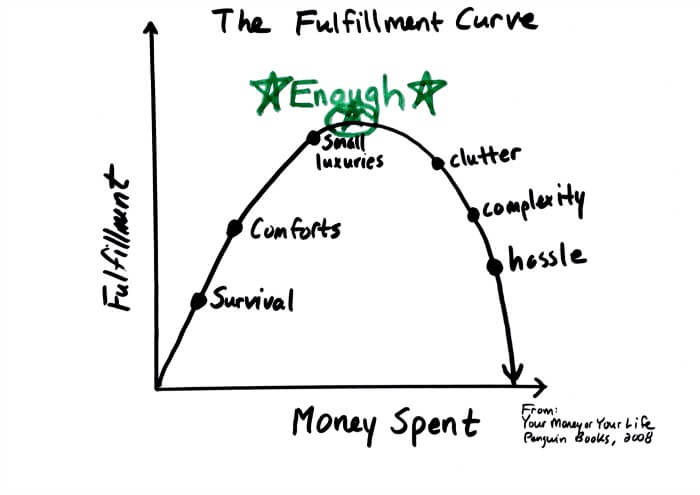
I think comfort and security work in a similar way. Early on, each additional unit of comfort and security produces amazing returns of fulfillment.
But there is a law of diminishing returns. The more you pursue comfort and security, the less fulfilled you become.
It looks like this:
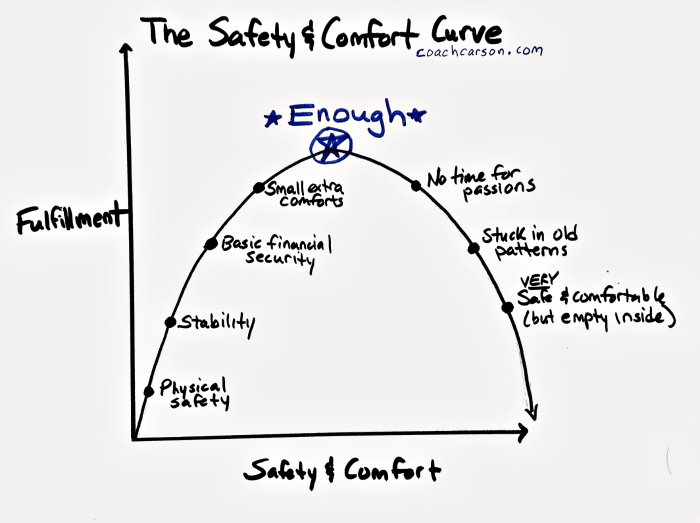
Everyone’s curve will look different. Some people need very little security, and others need a lot.
But the common theme is the downslope of the curve. This downward slide is when you begin sacrificing your self-actualization and growth for that extra bit of security and comfort.
And you know you’re on the downslope when you’re comfortable yet feel emptiness or desperation underneath. Henry David Thoreau described it like this in Walden:
The mass of men lead lives of quiet desperation. What is called resignation is confirmed desperation …
A stereotyped but unconscious despair is concealed even under what are called the games and amusements of mankind.
And like anything important, you’re the only one who can know where on the slope you are. You must pay attention and reflect on your life so that you can make decisions that serve you best.
In my own admittedly imperfect life reflections, I have found some practical tools to help me with my own struggle between comfort, security, and self-actualization.
Practical Tools to Balance Comfort, Security, & Growth
To help you (and me!) as we seek to balance comfort, security, and personal growth, here are a few practical tools I’ve picked up along the way.
Try Voluntary Discomfort
Set aside a certain number of days, during which you shall be content with the scantiest and cheapest fare, with coarse and rough dress, saying to yourself the while: “Is this the condition that I feared?
Let the pallet be a real one, and the coarse cloak; let the bread be hard and grimy. Endure all this for three or four days at a time, sometimes for more, so that it may be a test of yourself instead of a mere hobby. Then, I assure you, my dear Lucilius, you will leap for joy when filled with a pennyworth of food, and you will understand that a man’s peace of mind does not depend upon Fortune; for, even when angry she grants enough for our needs.”
~ Seneca, Letters From a Stoic
Sometimes we feel more comfortable and secure just be realizing that we already have enough!
Roman stoic philosophers and wise people from across time remind us that comfort and security do not have a fixed level. Many people are comfortable and secure with much less than you have.
The only way we can test our own limits, however, is by voluntary putting ourselves in situations of simplicity and even discomfort.
For me, camping and the outdoors have always reminded me of this principle.
I walk into the woods with just a backpack full of essentials. I walk out of the woods realizing how little I need to be happy.
It’s amazingly refreshing.
I may not always choose to live my life-like I’m backpacking. But my awareness and memories of the experience keep things and comforts in their proper perspective. I’m less likely to sacrifice the other things that matter more.
Seek Financial Plateaus as You Climb Towards the Peak
I often compare seeking financial independence to a climb up a huge mountain. They are similar because in either case, you won’t safely reach the peak in a rush. The journey is too long and perilous for a sprint up.
Instead, try breaking your big financial security goals into stages (i.e. plateaus). The plateaus I’ve personally found over the years look something like this:
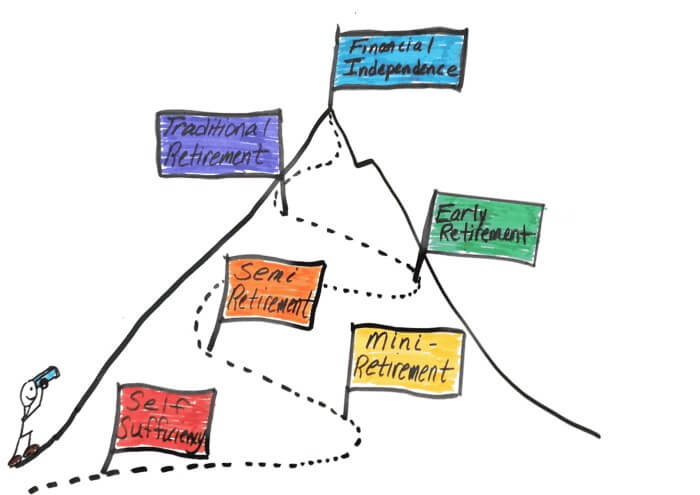
Plateaus allow you time to rest, recover, and live your life. And you can fill these spaces (whether it’s months or years) with the pursuit of opportunities that call your soul, even if that means staying in place on your climb towards financial independence.
One of my favorite plateaus is something called a Mini-Retirement.
Take Mini-Retirements
A mini-retirement is a pause from your normal life, often months or years at a time, to pursue something different. There are no rules for what you do. It could be time for travel, your family, intense study, or just a period of doing nothing!
The important part is listening to and nourishing the part of yourself that gets neglected during the periods of work and financial growth.
In 2009, my wife and I took our first big mini-retirement with a 4-month trip to Spain and then Peru, Chile, and Argentina in South America. It was a life-changing experience.
And now in 2017, my family (now with 2 kids) is spending 1+ years living in Ecuador. So far the experience has been amazing.
Build Entrepreneurial Skills & Mindset
Some people hear about the plateaus above like mini-retirements and get filled with fear. It might be hard to imagine ejecting yourself early from the security of a job and a career path in order to pursue other life callings.
But in my experience, a strong entrepreneurial mindset and a diverse set of entrepreneurial skills give you a safety net beyond just saving and compounding money in the bank. This entrepreneurial safety net makes the uncertainty of the future more palatable.
For example, during my 15 years as a real estate entrepreneur, I’ve been forced to learn and get better at a variety of related fields and skill sets such as:
- Bookkeeping & accounting
- Real estate title and paralegal work
- Property management
- Real estate agency
- Banking and finance
- Construction and remodeling
- City planning & zoning
- Debt collections
- Private lending
- Marketing
- Sales
- Websites & social media
- Teaching
- Blogging
If you make a life-long commitment to being a student of your entrepreneurial craft, you can build a variety of skills too.
Having these various skills gives you confidence that you could switch to any one of the related careers relatively quickly if needed. They may not all be your favorites, but they could earn some extra money if needed.
These skills are like economic wings you can use to fly when needed. Victor Hugo eloquently describes it this way:
Be like the bird
That pausing in flight
While on boughs too slight,
Feels them give way
Beneath her, and yet sings,
Knowing she hath wings.
When you can fly financially using entrepreneurship, you become less anxious about the sometimes shaky ground underneath you!
Finding That Elusive Balance
Our lives are probably not the same as the extreme example from Brave New World which began this article. In reality, we fluctuate back and forth between the extremes.
Sometimes we tilt more towards comfort and security. Other times we tip back towards growth and fulfillment.
The balance between the two is elusive. I admit that I continue to bob back and forth myself.
But my own goal is to make the fluctuations less extreme over time. Although none of us will ever reach it, we can hope to close the gap between our ideals and our reality. And this pursuit makes us better and gives us a richer experience of life.
I’ll leave you with the closing of “The Song of the Open Road” by Walt Whitman. The poem seems to be about travel, but it’s really about the road of life. It’s a verse that inspires and challenges me regularly on the topics I’ve just shared with you:
Allons! the road is before us!
It is safe – I have tried it – my own feet have tried it well – be not detain’d!
Let the paper remain on the desk unwritten, and the book on the shelf unopen’d!
Let the tools remain in the workshop! let the money remain unearn’d!
Let the school stand! mind not the cry of the teacher!
Let the preacher preach in his pulput! let the lawyer plead in the court, and the judge expound the law.Camerado, I give you my hand!
I give you my love more precious than money,
I give you myself before preaching or law;
Will you give me yourself? will you come travel with me?
Shall we stick by each other as long as we live?