
Building Wealth One House at a Time, by John Schaub
Tens of thousands of ordinary people have made millions of dollars investing in the most humble of real estate investments, the single family house. I am one of them, and I have a unique perspective because I have helped thousands of others make their first million buying houses. Rather than put their trust in a company pension plan or the government, they have taken control of their financial destiny.”
– John Schaub
I was lucky enough to hear John Schaub speak early in my investing career. Right away I subscribed to his newsletter (which I still get today). After 18 years of studying his newsletters, book, and in-person classes, John’s ideas have had a profound impact on my real estate investing career.
I regularly gift John’s book Building Wealth One House at a Time to friends who are getting started in real estate. It’s an excellent place to start your real estate education.
What I love most about John’s strategies is their simplicity. And that’s not a bad word.
As Clare Boothe Luce said, “simplicity is the ultimate sophistication.” Complicated schemes look good on paper and sound exciting in seminars. But simple, powerful, well-executed ideas actually build wealth.
This rest of this article is a book review with a few of my favorite ideas from John’s book. I originally published the review in 2016, but I’ve updated it for 2020. Enjoy!
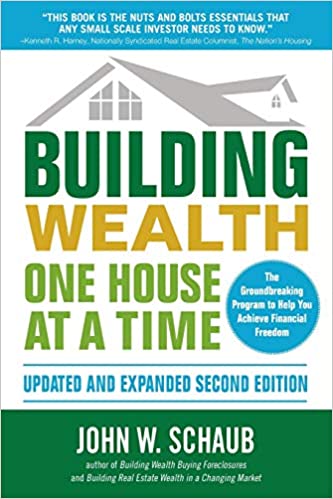
Buy Just One House at a Time … Become Wealthy
Building wealth one house at a time does not require a lot of education, money, or even time. It does require one thing – that you buy a house and hold it until you make some serious money.”
– John Schaub, Building Wealth One House at a Time
Smart people tend to over-complicate things. I’m really glad we have people like Elon Musk building rockets for us. But building wealth with houses is NOT rocket science.
Instead, it requires a simple plan that is executed with discipline over a long period of time.
Here’s John’s recommended wealth building plan:
- Buy one property
- Get it rented
- Pause to learn
- Repeat
This is the simple formula to build wealth one house at a time. If you do this, you’ll ensure that your next deal will always be better than the last. And over time, you’ll slowly and steadily build wealth.
And if you’re just starting, keep in mind that your first deal doesn’t have to be a home run.
Your First Deal Doesn’t Need to be a Home Run
It’s not even important that your first house is a great deal. The first house I bought I paid retail price for and made a 20% down payment. The good news is that I could rent it for a high enough amount to pay the expenses and pay the loan. The reason it has been one of my best investments is that I still have it … An investor with a doctorate in finance would never have bought that house, and he would have never held it for 30 years without refinancing it … He would have never turned a $7,000 investment into more than $300,000, not counting the rent that was collected for 30 years and will continue to be collected for the next 30 years.”
– John Schaub, Building Wealth One House at a Time
[my italics for emphasis]
That is really powerful stuff.
When you’re getting started, it’s easy to get analysis paralysis. It’s natural to be afraid of big mistakes.
But getting stuck doing nothing is an even bigger mistake. You need to do something because that’s where your true education begins.
My first real estate deal wasn’t a home run, either. My business partner and I underestimated repair costs and made many mistakes. But we found a relatively safe way to get started by using a credit partner. And we learned a LOT in the process that helped with our next purchases.
If you haven’t bought your first deal yet, make a commitment to get started. You can’t make money on houses unless you’re in the game.
Ensure your rent covers all of your expenses. Be sure to save a solid cash reserve (6 months of expenses is my minimum recommendation). But then, make a purchase.
Don’t be overwhelmed with the big picture or by competing with others who seem to be making “great” deals on every podcast you hear. Everyone walks before they run. Just take that first step.
Why Houses Are Your Best Investments
“After 32 years of investing, I still buy houses instead of apartments or shopping centers. Why? Houses make me more money with less work than any other investment.”
– John Schaub, Building Wealth One House at a Time
It’s a never-ending debate in real estate investing circles. Should you buy houses? Mobile home parks? Apartment buildings? Raw land? Or commercial buildings? There are pluses and minuses of each of these niches (and more). But I agree with John that for the average, small investor, you can’t beat houses for many reasons.
Here are just a few benefits of houses as investments that John points out in the book:
Houses Are Hybrid Investments
Houses are unusual in the investment world. They provide rental income, but their value doesn’t depend directly upon that rental income.
A 10-unit apartment building, for example, will go up or down in value depending upon how much net rent is produced. But a well-cared-for vacant house can go up in value just like a rented one.
Houses Are Safe
Even during bad real estate markets, a single family house in a nice residential neighborhood is a safe bet. People still need a place to live and are willing to rent or buy them.
Single family houses are like the blue chip stocks (i.e. stable investments) of the real estate world. There are many more buyers for houses than other types of real estate. Vacancies are typically shorter as rentals compared with commercial properties. And this all translates to safety as an investment.
Houses Have Non-professional Sellers
When you buy houses, you often deal directly with a seller. And often these sellers are not full-time, professional investors.
Why does this matter? Because full-time investors normally want to make a profit when they sell. And the pros are often better negotiators than you are.
A normal homeowner, however, will sometimes sell for non-financial reasons. Solving their problem can be worth money to them. This means you can sometimes buy for below-market prices and on attractive financing terms.
Unlimited Supply of House Deals
Every day new sellers decide to sell their houses. People move, start families, get divorced, retire, and pass away. There are many more single family houses in your average town than any other type of real estate investment. This means you’ll always have houses to shop for.
Houses Attract Lower Management Tenants
Compared with apartments, lower-end houses, and mobile homes, tenants for decent houses in decent neighborhoods are much more self-sufficient. They also tend to pay on-time more often. If you value a wealth of free time and addition to a wealth of money, this factor is crucial.
Houses Tend to Sell for Retail Prices and All Cash
This is perhaps the most compelling strength of single family houses. The federal government has a long-term vested interest in subsidizing the housing market. It’s very political that people are able to buy houses. As a result, many attractive home loan products are available.
This abundance of loan products allow owner occupant buyers to purchase your house when you need to sell. And these buyers are typically willing to pay retail price and cash you out.
But when you sell a mobile home park, commercial property, or apartment building, your buyer is also an investor. And typically, these investors are shopping hard for a bargain on price or terms.
Now, I’ve shared a number of reasons houses make good investments. But not just any type of house will do.
The Right House = More Profits & Less Hassle
Most people who buy real estate do not set out to buy a particular property. They just look at everything that is for sale and hope to find a good deal. Not all houses are created equal. Some houses will appreciate more; some will produce more cash flow because they will attract better tenants; and others will require more maintenance and have higher expenses. No house is perfect, but you can increase your profits significantly when you target a certain house to buy.”
– John Schaub, Building Wealth One House at a Time
This is such a HUGE lesson. Yet I’ve still made big mistakes ignoring John’s advice in the past.
Essentially John points out that you must balance the quantitative aspect of a deal (aka the numbers) with the qualitative aspects like quality of construction, size of house, type of lot, school district, road traffic, the price range, etc.
But balancing the quantitative and the qualitative is not easy. Many investors are attracted to very cheap prices on smaller, inexpensive houses. These cheap houses seem more profitable and safer just because the price is lower.
But many times a higher-quality house in a better neighborhood will be more profitable and safer over the long-run, even at less of a discount from retail price.
In my local market, I have found certain sweet spots for properties depending upon my goals.
If I am looking to maximize cash flow and loan amortization, I focus on houses, small multi-units, and mobile homes in C-class neighborhoods. Their value is typically about 50-70% of the median market price.
But if I am looking to maximize profits from capital gains and appreciation, B or even A-class neighborhoods higher in the price spectrum are much better. In my area this second type of property has a retail price hovering around 80-120% of median prices.
These properties are more difficult to buy at a huge discount. And the price-to-rent is not as good. But they are more liquid (easier to turn into cash), and the strong demand and limited supply keep their prices and rents rising.
John currently owns houses in the second type. But he and many other investors started with the first type and traded up to nicer properties over time when they were ready.
You’ll have to figure out which type of properties are the best for you at this point in your real estate investing career.
The Right House = Better Tenants & Less Hassle
When you choose the right house in the right neighborhood, you also make the management of your property MUCH easier. John Schaub explains:
The best tenants have their choice of houses to rent because every landlord with a vacancy would love to meet them. You can attract the best tenants in your town. The secret is simple …The right house will attract a superior tenant.”
We real estate investors (or our managers) focus a lot of time and effort collecting rent, reducing vacancies, and minimizing tenant problems. But ONE thing beats every other management strategy out there: buy a house your tenants want!
John’s ideal tenants are ones who pay on time, stay forever, and take care of the property. He’s found these ideal tenants look for the following criteria:
- Safe neighborhood
- House big enough to hold all their stuff
- House that is clean and in good repair
- A landlord who will maintain the property
- Fair rent
- Fair rent raises
- Privacy
- House that is not for sale
John has built his purchase criteria for houses around these eight core desires of his ideal customers. Because he’s able to provide these things to his customers, he routinely keeps tenants for five years or more. John says if someone stays two years or longer, he makes a profit, but if they move in one year or less, it costs him money.
I really like John’s business model because it balances earnings with less hassle. It allows you to make the most money AND use the least amount of your time and energy necessary.
When I choose teachers to emulate, I like to observe how they live their life. Do they practice what they preach and does it really work?!
John has invested for 40+ years and he manages all of his own properties (25+) with the help of a part-time assistant. He travels regularly for pleasure and spends time with his family. He writes newsletters, teaches courses, and helps others build wealth. And he’s a laid back guy who has a lot of fun with his hobbies (like flying airplanes!).
That’s the kind of person I’ve always wanted to model!
A Free and Clear Plan
The first step is to set a goal for the number of free and clear houses that you want to own.
Work backwards into this goal by first setting an income goal and then asking how many free and clear houses you will need to produce that target income.”
– John Schaub, Building Wealth One House at a Time
Here are the basics of John Schaub’s Free and Clear Plan.
Step #1: Set a Goal
If your financial goal is $5,000 per month, how many free and clear houses do you need?
Let’s say a house in a decent neighborhood rents for $1,200. Your operating expenses might be $500/month. So the net operating income (NOI) = $700/month.
$700 x 8 = $5,600/month.
So you need 8 houses free and clear to accomplish your goal. And since rents on good houses tend to keep up with inflation, there’s a good chance that your future net income will buy the same thing it buys today.
Step #2: Buy Houses
Buy one good investment house at a time, at a good price, with good terms, and hold it until it increases in price.
Step #3: Get Free and Clear
Plan A: Use increased cash flow from increasing rents to pay off your debt. If you borrow at a fixed payment and then make increased money from rents, from a job, or from other investments, you can use the cash flow to pay down debt (see the Rental Debt Snowball Plan)
Plan B: Buy more houses than you need, then sell some to pay off the rest. This plan requires managing more houses, using more leverage, and taking more risk, but the results can be spectacular (see the Buy 3-Sell 2-Keep 1 Plan).
Plan C: Refinance some houses to pay off others. Eventually, you may own several houses with small loan balances. But those small loans still have large payments. So, you can refinance one house at a low-interest rate, pull out equity from the house, and use it to pay off the other loan. If done correctly, you could have the same or better total cash flow but one property will be free and clear of debt. John points out that a debt of 80% on one house and 0% on the other is a much safer position for you than 40% on both.
Remember I said powerful strategies are simple? This free and clear plan from John has been one of my favorite simple strategies in all of real estate investing!
Build Wealth, Enjoy it, Share it
“Build wealth, enjoy it, share it” is the quote that John Schaub wrote when I asked him to sign my own copy of Building Wealth One House at a Time.
That fantastic creed partly inspired my own slogan at Coach Carson – “Invest in Real Estate. Achieve Financial Independence. Do What Matters.”
We all have a desire for security. So by all means, study how to win with money.
But if your entire life is dominated by a need for financial security, you’ll do nothing but grab for more and more and more. You’ll never take the time along the way to enjoy it!
In my case, the true pleasures in life are spending time with family and friends, reading a good book, and traveling. But these pleasures really require free time and flexibility a lot more than money.
When I realized that, it made me step back and reconsider how much money I really needed. More than enough money doesn’t make you happier if you have no time or freedom!
And John’s final lesson was to share your wealth.
No matter where we started, our success and growth was made possible to some extent by the help of others. So it’s only natural to share and pass it forward.
John really likes Habitat for Humanity, which he says was “founded on a simple concept: Rather than delegating to government the responsibility for housing the poor, housing that is expensive to build and maintain, Habitat solves the problem permanently by helping people in need of housing build and buy their own homes.”
The generosity of investors I admire like John, PhysicianonFire, and Tanya (OurNextLife.com), inspired me and my wife to donate 50% of our profits from Coach Carson, LLC to charity.
And beyond giving money, I thoroughly enjoy giving my time to local non-profits and causes that I believe in. It’s what financial independence is all about!
So now it’s your turn to follow John’s motto. Build wealth, enjoy it, and share it!
What did you think of the ideas from Building Wealth One House at a Time? Do you have your own simple yet powerful plan for building wealth? Have you found houses to be a solid investment? I’d love to hear from you in the comments below.